

Esophageal Manometry Redefined:
Precision for Better Respiratory Care
Our Solution
Revolutionizing Esophageal Pressure Monitoring for Advanced Respiratory Care
The Challenge: Prolonged ICU Stay for Obese Patients
Obese patients face higher risks in intensive care, with prolonged mechanical ventilation and increased difficulty in weaning off ventilators.
Our Differentiators
reduce complications, and shorten hospital stays.
Purpose
Mortality of patients with respiratory failure and obesity was reduced by about 50% when mechanical ventilation was associated with the use of esophageal manometry and electrical impedance tomography.
Florio G, Ferrari M, Bittner E, et al. A lung rescue team improves survival in obesity with acute respiratory distress syndrome. Crit Care 2020; 24:4.
Why Does This Happen?
- Lack of objective criteria for clinical decisions in ICUs;
- Prolonged stays in ICU, costing up to $30,000 per patient per day;
- Ineffective weaning from mechanical ventilation, increasing infection risk and length of stay;
- Patients with APACHE II scores >11, who undergo tracheostomy and reintubation, face higher mortality rates;
- Incorrect ventilator settings leading to Ventilator-Induced Lung Injuries (VILI)
- Low adoption of traditional esophageal manometry, due to being manual, time-consuming, and operator-dependent
Pneumdodrive Esophageal Pressure Monitoring
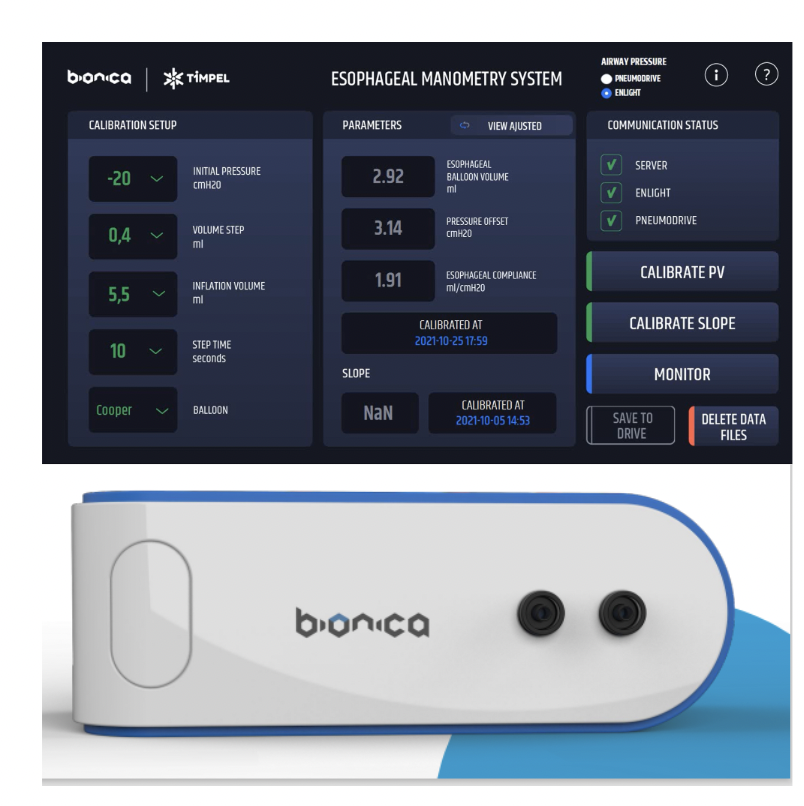
A medical device that monitors key characteristics of lung mechanics using a technique called esophageal manometry.
It brings automated, real-time, objective data to support critical decisions in the ICU — helping clinicians optimize ventilation, reduce complications, and shorten hospital stays.
Pneumdodrive
Esophageal Pressure Monitoring
Our Differentiators
Automated, real-time, objective data to support critical decisions in the ICU — helping clinicians optimize ventilation, reduce complications, and shorten hospital stays.

Advanced Esophageal Pressure Monitoring
Real-time esophageal manometry for precise respiratory assessment. Pneumodrive provides continuous esophageal pressure monitoring, allowing healthcare professionals to make informed decisions for mechanical ventilation management.

Automated Balloon Calibration
Ensuring accuracy with automatic pressure adjustments. Say goodbye to manual calibration—Pneumodrive automates the inflation process, reducing errors and improving efficiency in esophageal pressure measurement.

Optimized Ventilator Settings
Tailored mechanical ventilation strategies for critical patients. With precise esophageal pressure data, clinicians can optimize ventilator settings, preventing complications like ventilator-induced lung injuries (VILI) and enhancing patient recovery.

ICU Length of Stay Reduction
Helping patients recover faster and reducing hospital costs. By providing critical insights into respiratory mechanics, Pneumodrive supports faster weaning from mechanical ventilation, reducing ICU stay durations.

Seamless Data Integration
Compatible with hospital systems for streamlined workflows. Pneumodrive seamlessly integrates with existing hospital infrastructure, allowing real-time data analysis and enhanced patient management.

Portable & User-Friendly Design
Bringing innovation to the bedside with easy-to-use technology. Designed for efficiency, Pneumodrive is compact and intuitive, making esophageal manometry accessible beyond research centers and into everyday clinical practice.

Key Clients


Precision in the ICU:
Why Transpulmonary Pressure Matters
Transpulmonary Pressure Monitoring in Critically Ill Patients: Pros and Cons (Ball, Talmor & Pelosi – Critical Care, 2024)
This review explains the physiological rationale for measuring transpulmonary pressure…
Fundamental Concepts and the Latest Evidence for Esophageal Pressure MonitoringNight Colors
Shimatani et al. (Journal of Intensive Care, 2023) This paper…
Esophageal Pressure Monitoring and Its Clinical Significance in Severe Blast Lung Injury
Shifeng Shao et al. (Frontiers in Bioengineering and Biotechnology, May…
ROHA All right reserve @ 2025